Sofa Fabric Technical Specs Decoded: Weight, Width, GSM, and Composition Parameters
A sofa fabric specification sheet is short — usually five or six lines — and almost every line can be misread. Two fabrics can both be listed as “142 cm wide, 420 GSM, polyester” and still cut differently on a marker, wear differently on a hotel sofa, and behave differently in a repeat order three years later. The difference is rarely in the headline number. It sits in the tolerance, the construction, and what happens to the cloth after weaving.
This guide decodes those parameters from the buyer’s side of the table: what width, weight and GSM figures actually commit a mill to, how to read tolerances such as 142±2 cm and 420±10 GSM, and how a 100% polyester chenille differs in practice from a 90% polyester / 10% acrylic bouclé in the same width. The article uses real article data from OYD Textile (Haining OuYuda Textile Co., Ltd.), a sofa fabric and upholstery fabric manufacturer based in Haining, Zhejiang, China, producing chenille, woven, linen-look, velvet, circular knit, jacquard and outdoor fabrics, with roughly 95% of output exported to furniture factories, fabric distributors, wholesalers and project contractors worldwide.
The Spec-Sheet Problem: Same Numbers, Different Fabrics
Most quality disputes between mills and furniture makers do not start with a defective roll. They start with a specification that was precise about one number and silent about everything around it. Four gaps cause most of the friction.
- Width without a tolerance. “142 cm” and “142±2 cm” describe two different buying risks. The first is a claim; the second is an acceptance band that can be measured and rejected against.
- GSM as a single value. A fabric quoted at a fixed 420 GSM implies a precision that weaving and finishing rarely deliver. A band such as 420±10 GSM tells the buyer exactly how much legitimate variation to expect.
- Composition reduced to a fibre name. “Polyester” covers both a chenille pile yarn and a tightly woven bouclé. Fibre name alone says nothing about hand-feel, surface texture or how the cloth will behave during upholstery.
- Finishing omitted entirely. Water repellency, easy-clean treatment, dust resistance and fire-retardant finishing are applied after weaving and change how a fabric performs far more than a 20 GSM difference does.
Decoding the spec sheet is therefore the cheapest quality-control step available to a buyer, because it happens before a single metre is woven. It also protects the second and third orders, not just the first — the point at which most supplier relationships are actually won or lost.
Industry Background: Why Spec Literacy Became a Commercial Skill
The scale of the upholstery market means small specification misunderstandings repeat at industrial volume. Grand View Research estimates the global sofa market at USD 244.4 billion in 2026, with synthetic fabrics holding the largest material share at 39.8%. Within that market, Dataintelo values the performance segment — stain-resistant, high-durability furniture fabric — at USD 4.8 billion in 2025, with polyester accounting for a 38.4% material share.
Supply-side pressure is equally relevant. China exported USD 130.01 billion of textile yarns and fabrics between January and November 2025, a 0.9% year-on-year increase according to China Customs data. Buyers are not short of options, which is precisely why specifications have become the primary filter between suppliers that look similar on a quotation sheet.
Regulation has also become more specific about how upholstered products are evidenced. In the United Kingdom, the Furniture and Furnishings (Fire) (Safety) (Amendment) Regulations 2025 came into force in October 2025, removing the display-label requirement and focusing instead on permanent labels (statutory instrument 1988 No. 1324, as amended). The direction of travel is consistent across markets: fewer claims, more traceable product-level information.
The practical consequence for anyone sourcing sofa fabric is that the question has shifted from “is this polyester?” to “which polyester, at what weight, in what construction, held to which tolerance, and verified how?”
Parameter 1 — Width: What 142±2 cm Actually Commits the Mill To
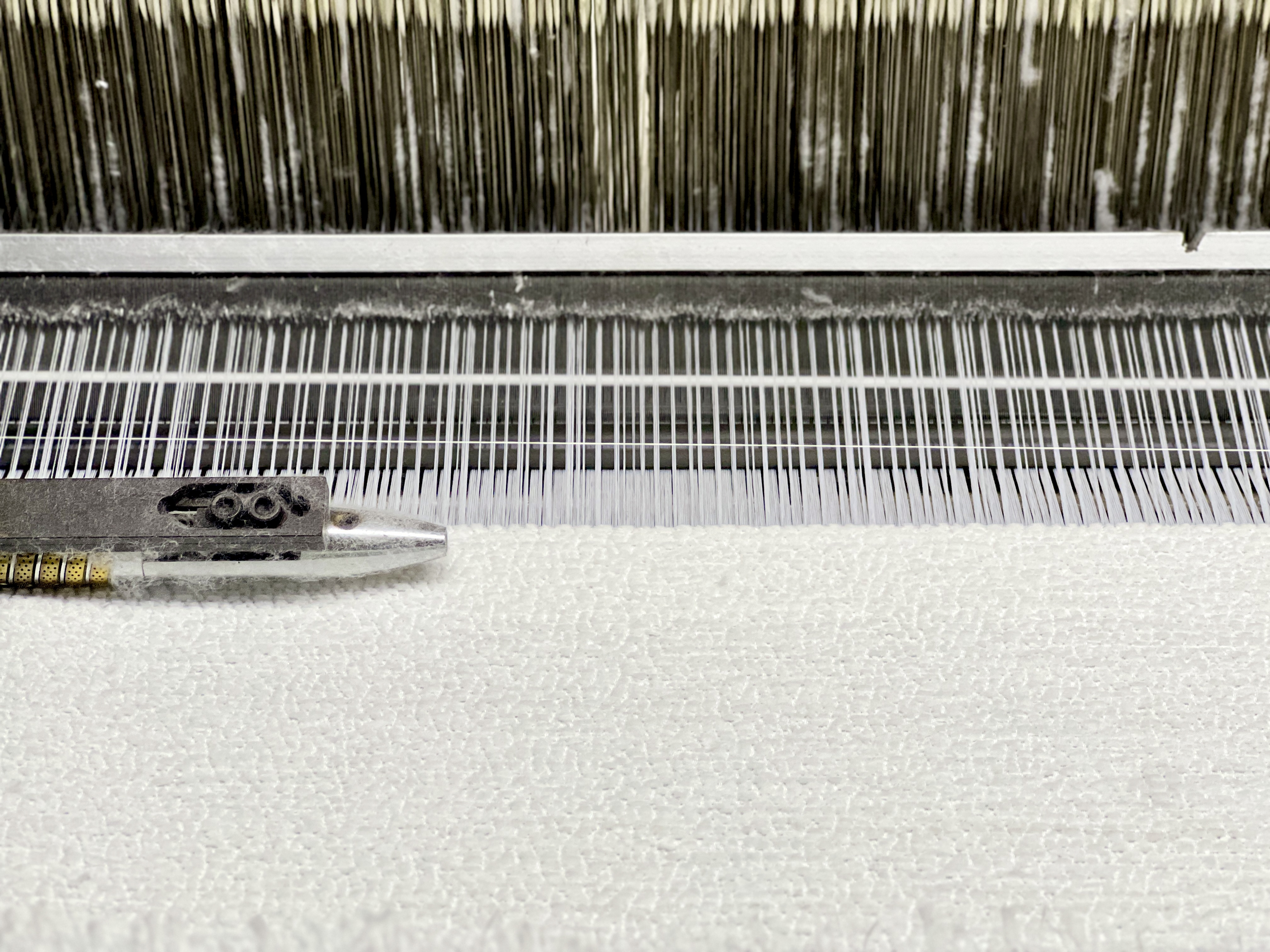
142±2 cm means the nominal width is 142 cm and the accepted range is 140–144 cm across the shipment. That single line on a spec sheet changes three things in a furniture factory.
Cutting yield. Marker planning is built on a guaranteed usable width. If a cut plan assumes 142 cm and a roll arrives at 140 cm, the same sofa panel set may require more linear metres, unless the pattern can be re-nested. The result is not a catastrophic failure — it is a slow, invisible cost that shows up in consumption variance at the end of a production run.
Symmetry on visible panels. For patterned or directional fabrics, including chenille and velvet upholstery fabric, panels are usually mirrored or matched. A wider usable width allows more efficient panel pairing; a narrow one forces compromises that become visible on the finished sofa.
Repeatability over time. The real value of a tolerance is that it is repeated on order two, order five and order twenty. Every OYD Textile article referenced in this guide is quoted at 142±2 cm, so a buyer switching between articles inside the range — say from a 420 GSM chenille to a 620 GSM bouclé — is working with a constant width assumption.
Parameter 2 — Weight and GSM: Reading 400±10 Through 620±10
GSM means grams per square metre. It is a mass measurement, not a performance rating, and it is the parameter most often over-interpreted during fabric selection.
The tolerance matters as much as the number. 420±10 GSM defines a 410–430 GSM acceptance window. A roll delivered at 413 GSM is inside specification; a roll at 395 GSM is not. Without a stated band, neither buyer nor mill has a reference point when a dispute arises.
Sofa fabric weight in the OYD Textile range moves in clear steps, which makes the commercial logic of a fabric programme easier to read:
- 400±10 GSM — chenille constructions such as OYD2919 and OYD3591. The lightest group in this comparison set, typically chosen for volume furniture production where consumption per unit is the dominant cost variable.
- 410±10 GSM — OYD2500, a slightly denser chenille.
- 420±10 GSM — OYD2992 and OYD3120, the mid-weight chenille band.
- 450±10 GSM — OYD3618, a velvet construction.
- 490±10 GSM — OYD1825, a heavier chenille.
- 620±10 GSM — OYD3229, a heavyweight woven bouclé-style fabric.
What GSM does not tell you is durability. Abrasion resistance and pilling depend on fibre quality, yarn structure, weave density and finishing. In a direct comparison against conventional velvet upholstery, OYD Textile reports abrasion resistance of 45,000 cycles and a pilling grade of 4–5, against 3–4 for ordinary velvet, with approximately 8% lower water consumption in dyeing and finishing. Those are construction and process outcomes, not weight outcomes — which is exactly why weight and performance should be read as two separate columns on any evaluation sheet.
A second common misreading: heavier is not automatically harder to source. A 620 GSM bouclé consumes more yarn and generally moves through weaving and finishing more slowly than a 420 GSM chenille, so weight affects cost structure and scheduling as much as it affects hand-feel.
Parameter 3 — Composition: 100% Polyester Chenille vs 90% Polyester / 10% Acrylic Bouclé
Composition should be read as a ratio attached to a construction, not as a fibre name. Two articles from the same supplier make the point clearly.
OYD3120 — 100% Polyester Chenille, 420±10 GSM, 142±2 cm
Chenille is built from pile yarns that give the surface a soft, directional hand and a subtle sheen shift depending on viewing angle. A single-fibre polyester construction is straightforward to dye consistently, easy to clean in daily use and predictable in upholstery handling. As a mid-weight chenille sofa fabric, OYD3120 sits in the band most furniture factories choose for mainstream sofa programmes where colour consistency across large production runs is critical.
OYD3229 — 90% Polyester / 10% Acrylic, 620±10 GSM, 142±2 cm
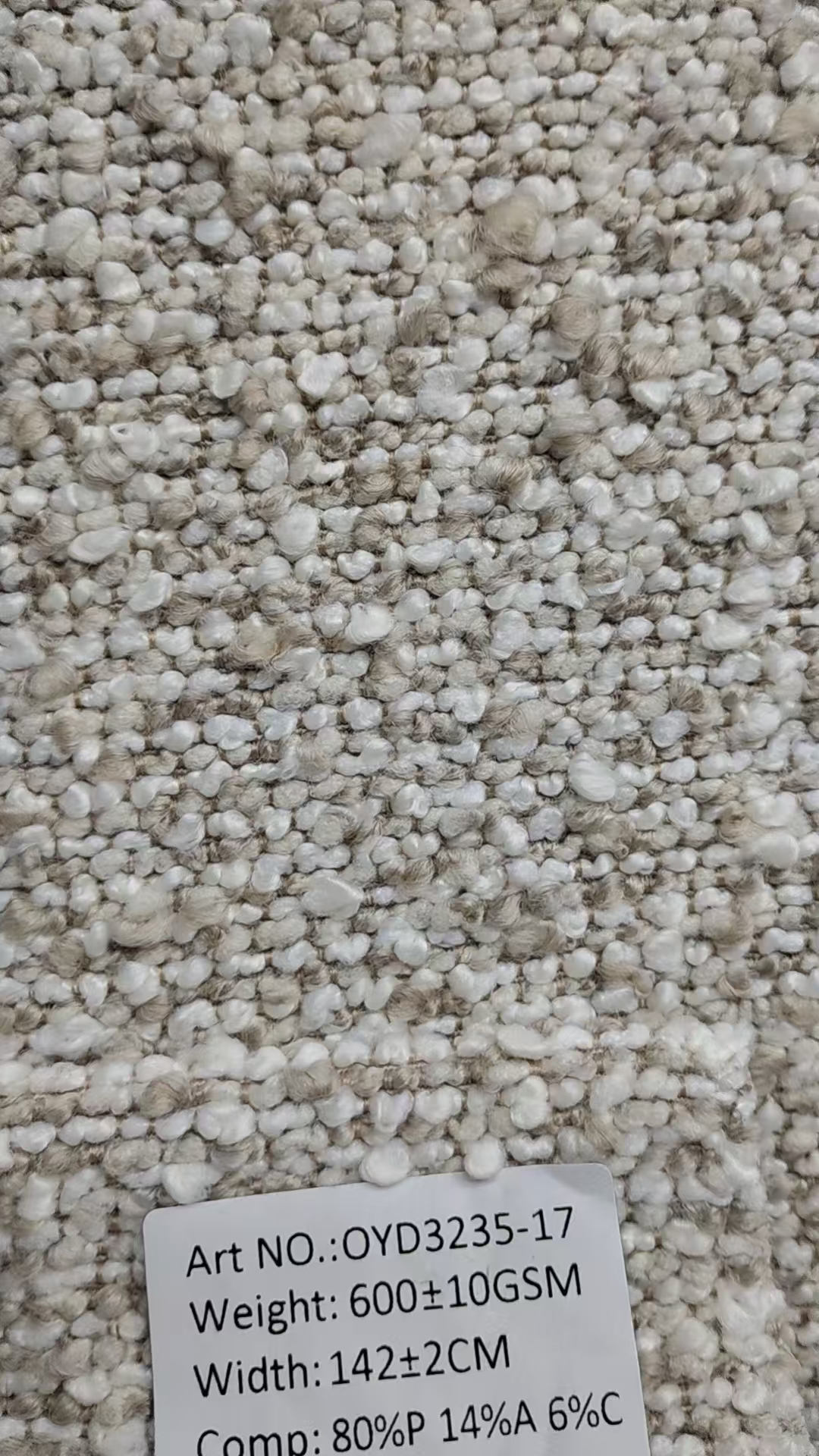
Bouclé-style constructions use looped yarn to create a raised, textured surface — the fabric reads visually heavier and more tactile than a flat weave at the same distance. The 10% acrylic in OYD3229 is not decoration: acrylic fibre typically contributes loft, a softer and slightly hairier hand, and different dyeing behaviour compared with a pure polyester yarn. At 620±10 GSM it is the heaviest article in this comparison set, with roughly a 200 GSM gap above OYD3120.
In practice, that 200 GSM gap combined with a looped construction produces four differences a buyer will notice:
- Presence and volume. Heavier looped fabric holds more shape on a seat cushion and reads as a more upholstered, premium surface — which is why bouclé sofa fabric is often specified for statement sofas, lobbies and designer-led interiors.
- Handling during upholstery. Looped and heavier constructions demand more care at seams and corners, and consume more physical volume when folded around frames.
- Cleaning behaviour. A textured loop surface traps dust differently from a smooth chenille pile, which is why easy-clean and stain-resistant finishing choices matter more on bouclé than on flat woven fabric.
- Yield planning. At the same 142±2 cm width, the heavier fabric weighs more per linear metre, so transport weight, roll handling and container loading need to be planned on weight rather than metreage alone.
Neither construction is “better”. Chenille tends to suit high-volume programmes where consistency, cleaning ease and cost control dominate; bouclé tends to suit projects where surface character and visual weight dominate. Reading the composition ratio tells you which conversation you are actually having.
Parameter 4 — Finish and Certification: The Lines Most Buyers Skip
Everything covered so far describes the fabric as it leaves the loom. Finishing and certification describe what it can do in the room.
Functional finishing. OYD Textile supports special finishing including waterproof treatment, easy-clean and anti-fouling treatment, dust resistance and fire-retardant finishing, alongside customisation of pattern, colour, weight and width. For hospitality and contract furniture, this is often the difference between a fabric that survives a project and one that is replaced within a year. Waterproof and stain-resistant sofa fabric specifications should always be stated as a finish on a named article, not as a general factory capability.
Certification as a verification marker. Two frameworks come up repeatedly in upholstery sourcing: GRS (Global Recycled Standard), which verifies recycled content claims within a textile supply chain, and OEKO-TEX, which tests textiles for restricted and harmful substances. Both are third-party programmes, and both are only meaningful when the certificate names the specific article and colourway being purchased. A logo on a website is not a scope document. The useful question is not “are you certified?” but “which of these article numbers, in which colourways, fall inside the current certificate scope?”
Testing evidence. OYD Textile’s fabrics can pass international standard tests for abrasion resistance and colour fastness, which is the performance baseline expected for high-volume furniture production projects. Quality control runs from raw-material incoming inspection, through in-process production monitoring, to pre-shipment final inspection — the last of which buyers are welcome to attend or arrange independently.
Comparison Table: Reading the Whole Range on One Page
The table below lists article specifications exactly as they are quoted. The “Notes” column is descriptive of the quoted data only, not a performance ranking.
| Art. No. | Construction | Composition | Weight (GSM) | Width (cm) | Notes |
|---|---|---|---|---|---|
| OYD3626 | Woven | 100% Polyester | 350±10 | 142±2 | Lightest construction in this set |
| OYD2919 | Chenille | 100% Polyester | 400±10 | 142±2 | Entry-weight chenille |
| OYD3591 | Chenille | 100% Polyester | 400±10 | 142±2 | Second 400 GSM chenille option |
| OYD2500 | Chenille | 100% Polyester | 410±10 | 142±2 | Mid-weight chenille |
| OYD2992 | Chenille | 100% Polyester | 420±10 | 142±2 | Mid-weight chenille |
| OYD3120 | Chenille | 100% Polyester | 420±10 | 142±2 | Mid-weight single-fibre chenille |
| OYD3618 | Velvet | 100% Polyester | 450±10 | 142±2 | Velvet upholstery construction |
| OYD1825 | Chenille | 100% Polyester | 490±10 | 142±2 | Heavier chenille |
| OYD3229 | Woven, bouclé-style | 90% Polyester + 10% Acrylic | 620±10 | 142±2 | Heaviest; two-fibre blend |
Read horizontally, the table is a weight ladder from 350±10 to 620±10 GSM at a constant 142±2 cm width. Read vertically, it shows that composition changes independently of weight: OYD3120 and OYD2992 share a 420±10 GSM band and a 100% polyester composition but are separate articles, while OYD3229 uses a two-fibre blend to reach 620±10 GSM in a looped construction.
Step-by-Step: How to Read a Sofa Fabric Spec Sheet in Six Steps
Step 1 — Read width with its tolerance, then check it against your cut plan
Confirm the guaranteed minimum usable width, not the nominal figure. If your marker assumes 142 cm, the 140 cm floor of a 142±2 cm specification is the number that matters for yield planning.
Step 2 — Convert GSM into an acceptance band
Write the band into your purchase order: 420±10 GSM becomes 410–430 GSM acceptable. This single change turns a subjective argument into a measurable inspection point.
Step 3 — Read composition as a ratio, not a category
“100% Polyester” and “90% Polyester + 10% Acrylic” are different materials with different hands, dyeing behaviour and cleaning characteristics. The ratio explains why two fabrics at similar weights feel different.
Step 4 — Identify the construction
Chenille, velvet, woven, linen-look, circular knit, jacquard and outdoor constructions each handle differently on a cutting table and each suits different end uses. Weight and composition alone cannot tell you how a fabric will fold at a corner.
Step 5 — Check what happens after weaving
Waterproof, easy-clean, anti-fouling, dust-resistant and fire-retardant finishes should be named explicitly on the specification. Unstated finishing is the most common source of “the sample behaved differently from the bulk” complaints.
Step 6 — Attach evidence and inspection terms
Request test evidence for abrasion and colour fastness, confirm certification scope by article number and colourway, and agree inspection terms before production. OYD Textile’s standard commercial terms include MOQ from 300 metres per colour, FOB delivery, pre-shipment quality inspection, and payment at 30% deposit with 70% before shipment.
Use Cases: How the Same Parameters Are Read Differently
High-volume furniture manufacturing
A factory producing a fixed sofa model reads width first and GSM second, because cutting yield and repeat-order consistency dominate unit economics. A 400±10 to 420±10 GSM chenille sofa fabric at 142±2 cm is the typical choice, with the tolerance bands written into the order so incoming rolls can be checked without debate.
Hotel and hospitality projects
Project buyers read finishing and evidence before weight. A 620±10 GSM bouclé such as OYD3229 suits lobby and lounge furniture where surface character matters, while stain-resistant or easy-clean finishing and fire-retardant finishing address the operational reality of commercial use. For UK projects, permanent labelling requirements under the 2025 amendment mean the fabric’s compliance information needs to travel with the finished product.
Fabric distributors and wholesalers
A distributor reads the range, not the article. A single supplier offering a 400 / 410 / 420 / 450 / 490 / 620 GSM ladder at one constant width lets a distributor cover multiple price points and applications — from volume furniture to luxury sofa fabric for designer-led interiors — without rebuilding its cut plans or sample library for each tier.
Interior designers and salon projects
Design-led buyers read composition and construction first: chenille for softness and colour range, velvet upholstery fabric for depth of shade, bouclé for texture, linen-look and jacquard for pattern. The specification question becomes whether the chosen surface survives the cleaning regime of a salon or hotel, which brings the finish column back into the decision.
From Spec Sheet to Long-Term Supply: Why Tolerances Are the Real Contract
A single shipment can be right by accident. A five-year supply relationship cannot. For furniture factories and distributors, the value of a fabric programme is that article numbers, tolerance bands and finishing specifications stay stable as volumes move between models and seasons.
That is the practical argument for treating the spec sheet as a multi-year document rather than a first-order formality. When a chenille article is reordered twelve months later, the buyer should be able to rely on the same 142±2 cm width, the same GSM band, and the same finishing definition — otherwise the cut plan, the cost model and the finished sofa all shift, quietly and expensively.
OYD Textile operates from its own manufacturing base in Haining, Zhejiang, with 25 years of fabric manufacturing experience, an annual output of 13,000,000 metres, and an in-house design and development team of 5 designers supported by 3 production managers, launching hundreds of new fabric designs each year across modern minimalist, wabi-sabi, light luxury and classic European styles. Around 95% of production is exported, covering markets in Europe, the USA, the Middle East, South America and East Asia.
Two honest limitations are worth stating. First, custom patterns, colours and special finishes carry a higher minimum order quantity and a longer production lead time than stock items, because both depend on yarn and dyeing conditions. Second, certification and test evidence is only meaningful when it is matched to the specific article number and colourway you are buying — so scope should be confirmed per order rather than assumed from a catalogue.
Frequently Asked Questions
1. What do GRS and OEKO-TEX certification actually confirm about a sofa fabric?
GRS (Global Recycled Standard) verifies recycled content claims within a textile supply chain, while OEKO-TEX testing addresses restricted and harmful substances in textiles. Both are third-party programmes, and both are only meaningful when the certificate identifies the specific article number and colourway you are purchasing. Ask for the scope document rather than a logo. Separately, fire performance requirements are set by regulation and differ by market — in the UK, the Furniture and Furnishings (Fire) (Safety) (Amendment) Regulations 2025 came into force in October 2025, removing the display-label requirement and concentrating on permanent labels for upholstered products.
2. Does a higher GSM always mean a more durable sofa fabric?
No. GSM measures mass per square metre and says nothing directly about abrasion or pilling resistance. Durability comes from fibre quality, yarn structure, weave density and finishing. In OYD Textile’s comparison against conventional velvet upholstery, its fabric is reported at 45,000 abrasion cycles with a pilling grade of 4–5, against 3–4 for ordinary velvet, together with approximately 8% lower water consumption during dyeing and finishing. A 420±10 GSM fabric with a strong construction and finish can therefore outperform a heavier article with a weaker build — which is why weight, construction and test evidence should always be read together.
3. What drives the cost difference between a 420 GSM chenille and a 620 GSM bouclé?
Three things mainly. First, yarn consumption: a 620±10 GSM construction uses substantially more yarn per linear metre than a 420±10 GSM construction at the same 142±2 cm width. Second, process time: looped bouclé-type structures generally weave and finish more slowly than flat chenille, and acrylic content changes dyeing behaviour. Third, order structure: stock articles can be produced on existing programmes, while custom patterns, colours and special finishes require higher minimum order quantities and longer lead times because they depend on yarn and dyeing conditions. Consumption per sofa, not price per metre, is usually the number that decides the project.
4. Can I evaluate a sample before committing to a bulk order?
Yes. Free fabric samples are available for evaluation before bulk order. To make a sample genuinely useful, check it the way you would check an incoming shipment: measure the width after relaxation, confirm the GSM band, fold it around a frame corner to assess handling, and test the finish behaviour against the cleaning products your end customer actually uses. If you are working through OYD Textile’s sofa fabric range, the sample and the specification sheet should arrive together, so the sample you approve is the specification you order against.
5. How do I evaluate a long-term chenille sofa fabric supplier for a furniture factory?
Judge on repeatability rather than on a single shipment. A supplier worth keeping should be able to state article numbers with fixed width and GSM tolerances, keep the same finishing definition across reorders, provide abrasion and colour fastness evidence, accept inspection terms, and hold a stable production lead time as volumes grow. OYD Textile’s standard terms include MOQ from 300 metres per colour, FOB delivery, pre-shipment quality inspection, payment at 30% deposit with 70% before shipment, and stable lead times for repeat programmes. The clearest test is simple: order the same article number twice, several months apart, and compare the two deliveries against the same spec sheet. If both pass, you have a supply relationship rather than a transaction.
Conclusion: Four Numbers, One Repeatable Standard
Sofa fabric specifications are not marketing copy. Width defines your cutting yield, GSM defines an acceptance band, composition defines hand-feel and handling, and the finish and certification columns define what the fabric can survive in a real room. Read together — for example, OYD3120 at 100% polyester chenille, 420±10 GSM, 142±2 cm against OYD3229 at 90% polyester / 10% acrylic bouclé, 620±10 GSM, 142±2 cm — they describe two different products for two different programmes, even though both sit inside the same supplier range and the same width band.
The buyers who get the most from a fabric supplier are the ones who specify at this level of detail on the first order, and then hold the specification constant for every order after it.
Next step: match a specification to your project
OYD Textile supplies chenille, woven, velvet, linen-look, circular knit, jacquard and outdoor upholstery fabrics at 142±2 cm width, with weights from 350±10 to 620±10 GSM, and supports custom pattern, colour, weight, width and special finishing such as waterproof, anti-fouling, easy-clean and fire-retardant treatment.
Request free fabric samples, a quotation, or the full product catalogue: Download the OYD Textile catalogue (PDF).
Contact: June · Email sofacloth@ouyudatex.com · Tel / WhatsApp +86 18857316802 · Chat on WhatsApp. Address: NO.150 XuCun Road, XuCun Town, Haining City, Zhejiang Province, China.
Have Questions or Need More Details?
Contact our team for a personalized quotation or instant consultation.
Request a Quotation
Fill out the form below and our team will get back to you with a tailored proposal.
WhatsApp Direct Chat
Prefer to chat in real-time? Message us on WhatsApp for instant assistance & quick answers.
- Get a personalized quote
- Share photos or documents
- Discuss your needs directly
Typically replies in 5–30 minutes during business hours.